How Much Time Does Project Managing Your Own Extension Actually Take?
 By Ben Murrell, independent project manager in South West London. Ask me a question →
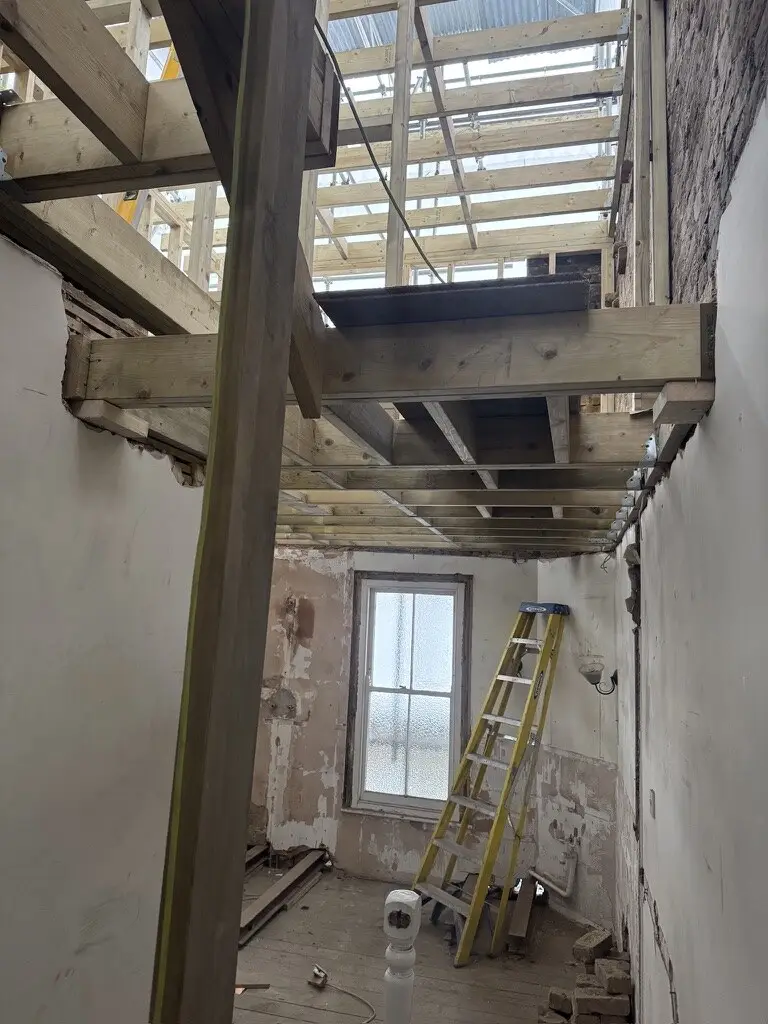
People ask me whether they should run their own extension to save the fee. The honest answer is sometimes yes. The part nobody puts a number on is the time. An extension does not only need decisions. It needs someone who can make them on the day the builder asks, and who can tell a fair extra from a hopeful one.
I am Ben Murrell. I used to run a residential building company. I now work client-side for homeowners in South West London. This is the week I see when the homeowner is the project manager, and the week I see when someone else is.
The hours are not the site visits
A builder's programme for a single-storey kitchen extension is often sold as 12 weeks. On the jobs I see it is closer to 17 or 18, and that is only the build. The management sits around it.
Before anyone digs, someone has to make three quotes describe the same job. That is not an evening. It is several evenings: reading exclusions, ringing back on the drains, the steel, the kitchen, the bifolds, and writing down what each price does not include. If you have not done it before, budget two or three weekends, not one phone call. There is a checklist for comparing quotes if you are doing this yourself, and a longer note on provisional sums.
Once the job is live, the load is not a Monday site meeting. It is the Tuesday text while you are at work. The groundworker has hit a drain that was not on the drawing. The joiner needs a decision on the door lining before he can order. The glazing company will not book a survey until someone confirms the structural opening. None of these wait until Saturday.
On a straightforward rear extension I would expect the person running it to spend something like this:
- Before signature: 15 to 25 hours to get quotes onto the same scope, check the builder, and put a written contract and payment schedule in place.
- During the build: 4 to 8 hours a week if the job is calm, and more in the weeks when steels, glazing or first fix land together. Over a 18-week build that is roughly 70 to 140 hours.
- At the end: a day to walk the snagging list properly, and then the chasing until it is closed.
That is a range, not a quote. A loft with one builder you already trust sits at the bottom. A side-return on a Victorian terrace, with party wall, a kitchen still in use, and a newborn in the house, sits at the top. Kaninka and Dan in East Sheen instructed me mid-build for that reason. Work and a new baby had made them the site's default decision engine. They did not lack interest. They lacked hours in the day.
What actually fills those hours
The time is not "project management" in the abstract. It is a short list of jobs that repeat.
- Answering the builder the same day. A trade stood still costs more than the answer. If you cannot reply until the evening, the day is often already lost.
- Checking that an extra is an extra. Some are real — a drain no one could see. Some are the thing the quote should have included. Telling them apart means reading the quote again, not trusting the conversation on the doorstep.
- Ordering, or approving, in time. Steel, glazing and a kitchen all have lead times. A decision that slips a week does not cost a week. It costs the gap until the next slot.
- Keeping neighbours and party wall in step with the dig. On a terrace this is not optional admin. It is the thing that stops the start date being fiction.
- Paying against what is built, not against the date on the invoice. That means a site look, or photos you trust, before money moves.
If you enjoy this, and you can be reached, you can do it. Plenty of single-storey extensions in London are built well without anyone like me. I would rather say that than sell you a service you do not need. There is a fuller test in do I need a project manager for my extension.
Where the time turns into money and pressure
The fee question and the stress question are the same question. The person who cannot answer on Tuesday either delays the job or says yes to get the trade moving. Delay shows up as preliminaries and a kitchen that is out of action for longer. A rushed yes shows up as a variation you cannot quite reconstruct later.
That is the pressure clients describe. Not drama. The low-level dread that a wrong yes costs thousands, and that the builder will ring during a meeting. Catherine and Rob in Wandsworth said the useful thing was that it stayed calm, and that someone was a call away. Anita and Simon in Fulham put money and stress in the same sentence. Both were describing the same gap: someone on their side who already knew which questions to ask.
On a 20 m² single-storey extension the build cost I use for illustrations is about £64,000 to £84,000 ex VAT, at the London mid-range published alongside the extension cost calculator. At the standard level my fee is 11% of the project cost, about £7,000 to £9,200. It pays for itself only if the hours you get back, and the extras you do not agree, are worth that. On a small job with a builder you trust, the maths is often thin. On a job that needs a decision every other day, the hours above are the thing you are buying back. The worked version is on what a project manager costs.
A sensible split if you do not want the whole job
You do not have to hand over the build to get the expensive hours covered. The hours that hurt most are before signature and in the weeks when the structure and the glazing are in play. A lighter appointment — quotes lined up, contract and payment schedule set, then visits at the stages that are hard to undo — is the 10% end of the range. Full day-to-day is 12%. The middle is regular visits and a live budget.
If you want a second pair of eyes on quotes before you sign, send them over. If you already know you cannot be the person who answers the builder, say that at the start. Either way the first conversation is to work out whether you need me at all.
Talk it through · 07525 474 849 · benmurrell83@gmail.com